We often celebrate resilience at work without asking what made it necessary.
The disability tax is typically described in financial terms. Research published in the Disability and Health Journal found that working-age adults with disabilities spend more than $5,000 annually on disability-related expenses — nearly twenty percent of household income. Two-thirds report unmet needs for essential goods and services. These figures are significant, and they matter.
But defining the disability tax only in dollars obscures a broader workplace reality.
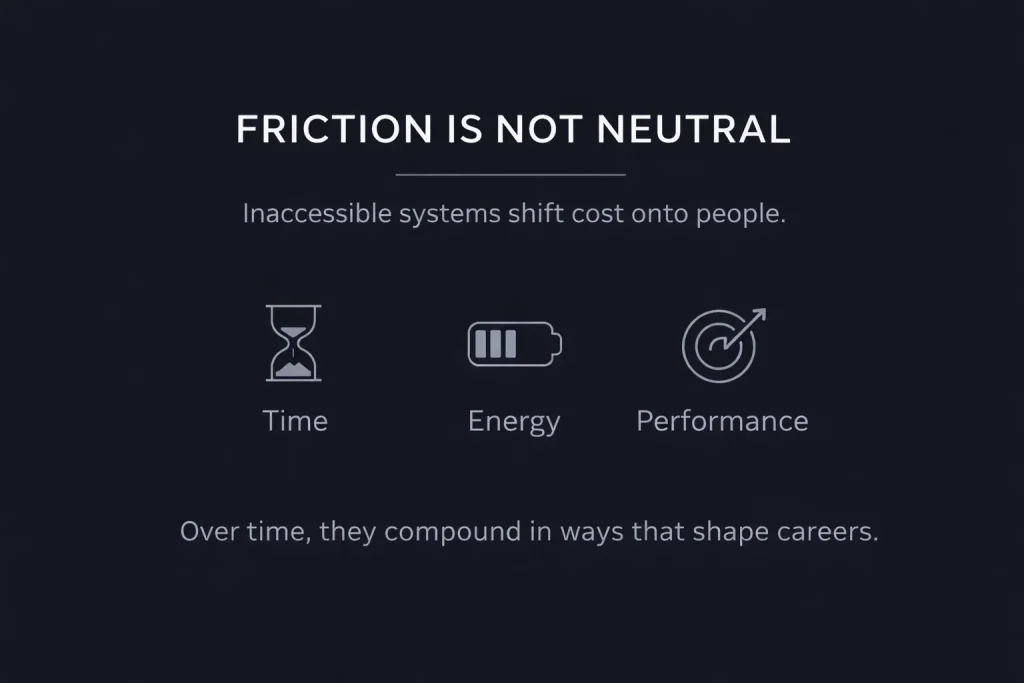
Inaccessible systems create friction. That friction carries cost. And in professional environments, those costs are paid in time, energy, credibility, and opportunity.
The workplace disability tax rarely appears on a balance sheet. Instead, it shows up operationally.
It appears when internal systems are incompatible with assistive technology and additional hours are required to complete routine tasks.
It appears when global meetings rely on inaccurate captions and missed context is attributed to the participant rather than the platform.
It appears when performance cultures reward constant responsiveness over sustained depth, and protecting focus time is interpreted as disengagement.
The friction does not disappear. It is absorbed by someone.
Over time, these dynamics shape how reliability is judged, how leadership potential is assessed, and who is seen as consistently delivering under pressure. Burnout increases through sustained compensatory effort. Visibility narrows. Advancement slows — not because of capability, but because of accumulated structural disadvantage.
When we label individuals as resilient without examining the systems that required compensation, we protect the design and scrutinize the person.
Many contemporary workplaces reward urgency over depth and visibility over outcomes. These norms are rarely neutral. When tools are inaccessible, when collaboration platforms introduce barriers, or when evaluation criteria prioritize speed over substance, friction is introduced into the system.
That friction becomes a hidden performance tax.
If participation depends on individual adaptation, the operating model itself requires redesign.
Accessibility is infrastructure. Infrastructure determines who can deliver consistently, sustainably, and without hidden cost.
The disability tax is not only financial. It is structural. And structural problems require structural solutions.