
Accessibility Is a Control Function, Not a Culture Statement
Many organizations position accessibility as a value. It appears in commitments, culture decks, and design principles. Those statements communicate intent, but intent alone does not shape operational outcomes.
Accessibility influences whether teams can deliver consistently across regions, time zones, formats, and technologies. It affects whether launches require last-minute remediation. It determines whether employees quietly compensate for preventable barriers. It shapes reputational and regulatory exposure when something fails publicly.
These are matters of execution, scale, and risk.
When accessibility is treated primarily as a cultural aspiration, implementation varies by team and by urgency level. Some groups integrate it into planning. Others address it only after issues surface. The result is inconsistency, downstream fixes, and uneven operational burden.
That burden is rarely tracked. It shows up as late nights reformatting materials, correcting inaccessible documents before client meetings, or translating information for colleagues. Over time, this additional labor becomes normalized as professionalism, even though it originates in preventable design gaps.
Mature organizations reduce variability through defined processes, review mechanisms, and clear ownership. Financial controls, security reviews, procurement gates, and safety protocols are embedded into workflows so outcomes do not depend on individual vigilance.
Accessibility affects performance in similar ways. When it remains peripheral, variability persists. When it is embedded into planning cycles, design reviews, development checkpoints, and launch criteria, implementation becomes more predictable.
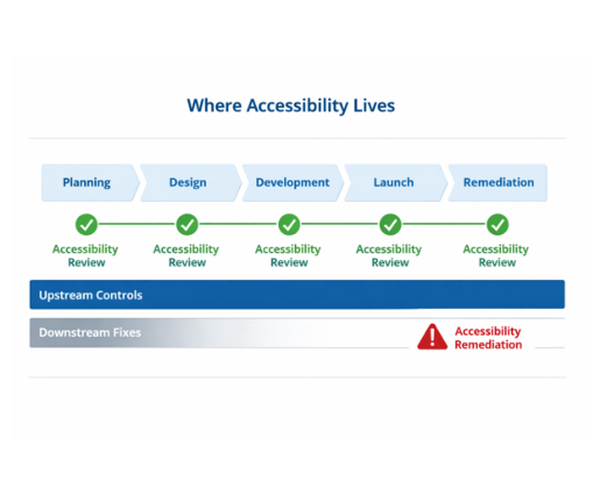
The difference is visible in where accessibility lives.
If it appears only at the end of a workflow, it becomes remediation. Teams shift resources from innovation to repair. Risk increases. Friction accumulates.
When accessibility is integrated upstream, fewer issues require correction. Expectations are clearer. Ownership is defined. Review becomes routine rather than reactive.
Embedding accessibility does not require parallel bureaucracy. It requires integrating expectations into existing operating models and treating accessibility as something that materially affects execution.
The longer accessibility depends on awareness alone, the more it relies on individual effort to bridge systemic gaps. That effort carries cost, even when it is not formally measured.
Operational maturity becomes visible in what is reviewed before launch and what leaders treat as non-negotiable. Accessibility shapes who can deliver consistently and who must compensate quietly. Integrating it into governance structures reduces hidden cost, strengthens reliability, and protects long-term performance.
Accessibility is infrastructure. Infrastructure determines whether inclusion is durable or dependent on individual heroics.